Residential Proxies for Web Scraping and Price Discovery
· based on the channel Lukas Margerie
Residential proxies are specialized proxy servers that route internet traffic through real residential IP addresses provided by internet service providers (ISPs). This makes them highly effective for web scraping tasks that require accessing geo-targeted content or avoiding detection by websites that block data center IP addresses.
What Are Residential Proxies and How They Work
Residential proxies differ from VPNs and data center proxies because each request appears to originate from an actual home internet connection. This helps websites see the traffic as coming from genuine local users rather than automated bots or centralized servers. Unlike a VPN that routes all traffic through a single server, residential proxies can rotate IP addresses across multiple locations, making them ideal for scraping data from sites with regional restrictions or anti-bot measures.
VPN vs Proxy for Price Discovery
A VPN typically routes all your internet traffic through one server, often a data center IP, which websites can easily detect and flag. Residential proxies avoid this by using IPs assigned to residential customers, making detection and blocking less likely. This is crucial when trying to uncover hidden prices or regional offers on platforms like Spotify, Canva, or Netflix, as these services display different pricing based on the user’s location.
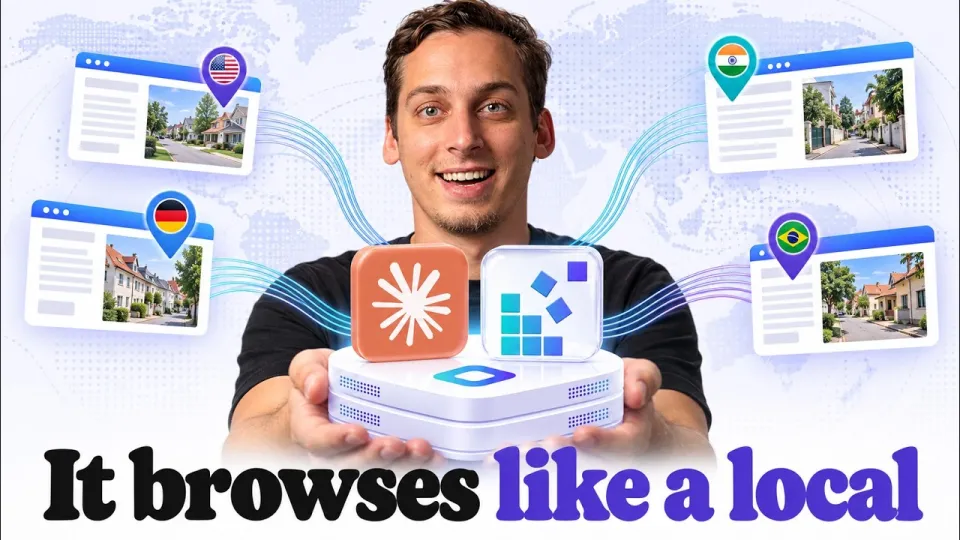
Video: This Claude Code Agent Uses Residential Proxies to Find Hidden Prices
Rotating Residential Proxies and Country Targeting
Rotating residential proxies automatically assign a new exit IP address for every connection or request. This avoids IP bans and rate limits commonly imposed by websites on repeated queries from the same IP. Additionally, residential proxies can be selected by country or region, allowing precise geo-targeting. For example, by using residential proxies with IPs from the US, Germany, Brazil, and India, one can scrape localized pricing data that would otherwise be inaccessible.
Using Residential Proxies with AI Agents and Web Scraping Tools
In the context of web scraping, residential proxies are often combined with automation tools and AI agents for efficient data extraction. For instance, the Claude Code AI agent demonstrated by Lukas Margerie uses residential proxies alongside Playwright, a browser automation library, to open pricing pages from different countries simultaneously. This setup enables the creation of detailed pricing teardowns without manual intervention or VPNs.
Regional Pricing Insights from Residential Proxy Data
By leveraging residential proxies, researchers can uncover significant price variations in SaaS subscriptions and streaming services. For example, Spotify Premium costs $12.99 monthly in the US but about $1.45 in India; Canva Pro is $144 annually in one region and about $42 in another. Such discrepancies highlight the importance for SaaS vendors and template sellers to understand geo-targeted pricing strategies and potential opportunities for market expansion.
Common Questions About Residential Proxies
Many users wonder about the best residential proxy providers and how to choose proxies for specific countries. DataImpulse is a recommended network for residential proxies, offering reliable IP pools with country-specific targeting. Another common question is how residential proxies maintain anonymity and avoid detection—this is achieved by using real ISP-assigned IPs that mimic genuine user traffic.
Useful Links
- DataImpulse Residential Proxy Network — residential proxy service used for geo-targeted scraping
- Claude Code AI Agent — AI tool for automating web data extraction
- Playwright Automation Library — browser automation tool used with proxies
Summary
Residential proxies provide a powerful solution for web scraping and discovering hidden regional prices by simulating real user connections from diverse locations. Their ability to rotate IPs and offer country-specific access makes them essential for competitive market analysis, price comparison, and uncovering geo-restricted content. The use of residential proxies combined with AI agents like Claude Code and tools such as Playwright streamlines data collection without the pitfalls of VPN detection or manual checking. For those interested in exploring residential proxies, DataImpulse offers a reliable platform to start.
This analysis is based on insights from Lukas Margerie’s detailed breakdown of residential proxies and their applications in finding hidden prices.
Key takeaways
- Residential proxies route requests through real home ISP connections.
- They enable geo-targeting by using IPs from chosen countries.
- Rotating residential proxies provide fresh IPs for each request.
- They help reveal regional pricing differences on SaaS and streaming services.
- DataImpulse is a leading provider of residential proxy networks.
Questions & answers
What is a residential proxy and how does it differ from a VPN?
A residential proxy routes your internet requests through real home ISP connections, making the traffic appear as coming from genuine local users. Unlike a VPN, which typically uses data center IPs and routes all traffic through one server, residential proxies provide IP addresses assigned to residential customers, reducing the chance of detection and blocking.
Why are residential proxies better for web scraping regional prices?
Residential proxies allow access to geo-targeted content by using IPs from specific countries, making websites think the requests come from local users. This helps reveal regional price differences that are often hidden when accessing sites from generic data center IPs or VPN servers.
What are rotating residential proxies and why are they useful?
Rotating residential proxies assign a new exit IP address for each connection or request. This prevents IP bans and rate limiting by websites, enabling continuous and large-scale web scraping without interruption.
How can I start using residential proxies for my projects?
You can sign up with a residential proxy provider like DataImpulse, which offers a wide pool of IPs with country targeting options. Combining these proxies with automation tools such as Playwright and AI agents like Claude Code can streamline data extraction and analysis.
Source: This Claude Code Agent Uses Residential Proxies to Find Hidden Prices · Markdown version